What’s the Difference Between Pre-Engineered and Custom Automation Cells?
In 2026, manufacturers are increasingly weighing the benefits of pre-engineered vs custom automation, especially when it comes to cost and lead time. If you’re exploring automation to cut labor costs, boost output, or standardize production, the type of system you choose will shape your budget, rollout speed, and long-term ROI. This guide compares the true cost of automation in 2026, outlines key differences between pre-engineered and custom systems, and shows how to choose the right solution for your facility. Whether you’re aiming for speed, scale, or flexibility, understanding this trade-off is essential to planning a smart automation strategy.
This guide breaks down:
- How much each type of system costs in 2026
- Lead times to install and start running
- Integration effort and risk
- Which solution is more scalable
- And ultimately, how to choose what fits your facility
If you’re budgeting for automation, considering multiple lines, or need to reduce labor costs quickly, understanding these differences can help you avoid delays and overspending, and get to ROI faster.
How Much Does a Pre-Engineered Automation Cell Cost in 2026?
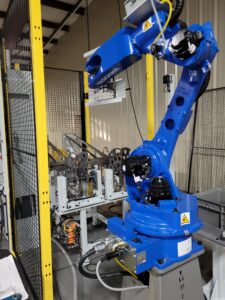
Pre-engineered automation cells are designed for manufacturers who want speed, reliability, and a lower upfront investment. These modular systems are purpose-built for common applications like palletizing, welding, or part handling, and they’re engineered to be ready quickly with minimal integration work.
What Do You Get with a Pre-Engineered Automation Cell?
A pre-engineered cell is typically a complete, standardized solution that includes:
- A robotic arm (industrial or collaborative)
- Safety enclosures and light curtains
- End-of-arm tooling for a specific task
- Base frame or pallet system
- Basic controls and user interface
- Pre-tested programming for standard operations
These systems are often delivered as turnkey packages, meaning you can install and start production with minimal adjustments. Because they’re designed for repeated use across multiple customers, they benefit from shared engineering costs and proven performance.
What’s the Price Range for Pre-Engineered Cells?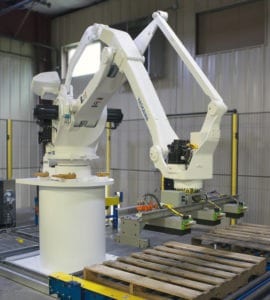
In 2026, most pre-engineered automation cells range from $100, 000 to $175, 000 depending on:
- Type of task (e.g. grinding vs. palletizing)
- Payload and robot size
- Level of customization (tooling, vision add-ons)
For example:
- A collaborative palletizing cell may start near $100K
- A high-throughput robotic palletizer with industrial safety enclosures could run closer to $175K
- Systems with integrated sensors, conveyor inputs, or complex tooling add cost but still stay below typical custom project ranges
Vendors offering pre-engineered cells usually publish fixed pricing or quick-quote packages, helping buyers budget accurately and quickly.
How Fast Can a Pre-Engineered Cell Be Delivered?
Another major advantage is speed: lead times for pre-engineered cells are often 4–8 weeks, and some are available in as little as 4–6 weeks through “quick ship” programs. This is possible because:
- Designs are already finalized
- Components are pre-stocked or sourced in batches
- Programming is pre-built for standard use cases
In many cases, MESH Automation helps customers go from purchase to production in under two months, minimizing downtime and accelerating ROI.
Is Integration Easier with Pre-Engineered Automation?
Yes, and that’s a major selling point. Pre-engineered systems are:
- Pre-wired and tested
- Delivered as one or two units
- Installed with known electrical and safety specs
- Often require only facility layout mapping and I/O connection
There’s no need for ground-up programming, complex debug cycles, or multiple rounds of commissioning. That simplicity reduces installation costs, shortens training time, and means less risk of operational surprises.
How Much Does a Custom Automation System Cost in 2026?
Custom automation systems are built from the ground up to solve a unique manufacturing challenge, and while they offer maximum flexibility, that customization comes with significantly higher costs, longer lead times, and greater complexity.
What Is Custom Automation, and When Do You Need It?
Custom systems are designed to handle non-standard, proprietary, or highly complex tasks that pre-engineered solutions can’t manage. These projects often include:
- Multiple integrated stations or robots
- Unusual part sizes or geometries
- Specialized sensors, tooling, or software
- Tight tolerances or advanced quality inspection
- Custom part handling, testing, or packaging steps
If your application doesn’t fit a “standard cell” mold, or if your competitive edge comes from a proprietary process, then a custom automation project may be your only path forward.
Why Is Custom Automation More Expensive?
In 2026, fully custom automation systems typically cost $300, 000 to $1 million or more, depending on the scope. Cost drivers include:
- One-time engineering and design (mechanical, controls, software)
- Custom-built frames, tooling, and robot configurations
- Extensive testing, debugging, and validation
- On-site integration, operator training, and documentation
For example:
- A custom material handling line with 2 robots and conveyors may cost around $400K–$600K
- A multi-step custom assembly machine with robotic pick-and-place, sensors, and packaging may reach $750K–$1M+
Because the system is designed specifically for one client, 100% of the development cost is borne by that project, unlike a pre-engineered solution where cost is amortized across many users.
How Long Does It Take to Build a Custom Automation System?
Lead times are another major consideration. Most custom projects take between 20 and 55 weeks (roughly 5–12 months), depending on complexity. This includes:
- Engineering and concept development
- Design approvals and procurement
- Mechanical build and controls programming
- Factory acceptance testing (FAT)
- On-site commissioning and training
Some smaller systems may be completed in under 6 months, but highly engineered solutions with multiple operations or precision components may extend well past a year. That timeline must be factored into planning for production shifts or labor replacement.
What Makes Custom Integration More Complex?
Custom systems involve significant coordination between the automation provider and the customer’s engineering, production, and safety teams. Each system is unique, which means:
- Mechanical and control interfaces must be designed from scratch
- Control logic is written specifically for the operation
- Debug and test cycles may require iterations
- Documentation and operator training are project-specific
While the result is a system tailored exactly to the customer’s process, it also comes with a higher risk of unexpected delays, scope changes, or rework, all of which can affect final cost and time-to-value.
 Pre-Engineered vs. Custom Automation: Which Is Better for ROI?
When planning automation in 2026, it’s not just the upfront price that matters, it’s how quickly you recover that investment and how adaptable the system is as your production evolves. This section compares key ROI factors that influence long-term value.
Which Option Costs Less to Scale?
Pre-engineered automation wins on scalability. If you need to grow production, it’s far easier, and cheaper, to replicate a standardized cell than to re-engineer a new system. For example:
- Adding another robotic palletizer or weld cell may cost the same or less the second time
- Standardized platforms often benefit from volume pricing or repeat-use discounts
- Pre-engineered cells are modular, you can add one at a time as needed
In contrast, custom automation systems are not easily duplicated. Each new deployment carries much of the original cost. Unless designed with replication in mind, building a second system often requires:
- Fresh procurement of custom parts
- New design validation
- New programming and testing cycles
Custom systems are scalable in throughput (you can build them to handle high volumes), but not necessarily in quantity without reinvestment.
Can Pre-Engineered Cells Be Repurposed?
To a degree, yes. Many pre-engineered platforms are built with adjustable tooling or configurable software, allowing them to:
- Handle new SKUs or product sizes
- Switch tasks with recipe-driven programming
- Swap end-of-arm tools for new operations
That means you can deploy a pre-engineered cell for one product today and repurpose it for another tomorrow, as long as the basic motion or payload needs are similar. It’s not unlimited flexibility, but it’s more than most realize.
Custom automation, on the other hand, is typically built for a single process. While it can be designed with some changeover or modularity, adapting it to a different product often requires new tooling, code changes, and engineering support. This limits long-term versatility unless those future needs were anticipated early in the design phase.
What If My Process Is Unique?
This is where custom systems shine. If your process involves:
- Unusual part geometries or handling methods
- Specialized inspection steps
- Multi-operation workflows
- Proprietary assembly or test sequences
Then a pre-engineered cell won’t fit, because it’s not built for your use case. Custom automation allows you to integrate exactly the operations you need, in the sequence you want, with the features your product demands.
For example:
- A medical device manufacturer may need a system that assembles, heat-seals, vision-inspects, and laser marks, all in one line.
- A packaging company may want to combine robotic case packing, lid placement, and shrink wrapping into one custom-built solution.
Pre-engineered platforms can’t do that. They’re powerful for standardized tasks, but custom solutions are required when your product or process doesn’t match the mold.
How to Choose the Right Automation Approach
If you’re facing the decision between pre-engineered and custom automation, the key is to balance speed, budget, and complexity. It’s not just about which option is “better”, it’s about what matches your product, production goals, and timeline. Each solution comes with its own strengths, trade-offs, and value drivers.
To help guide that decision, here’s a side-by-side comparison of the two approaches as they stand in 2026:
| Factor | Pre-Engineered Automation Cell | Custom Automation System |
| Typical Cost | $100, 000 – $175, 000 | $300, 000 – $1M+ |
| Lead Time | 4–8 weeks | 20–55 weeks (5–12 months) |
| Integration | Plug-and-play, low effort | High engineering, tailored interfaces |
| Flexibility | Moderate (within standard use case) | Maximum (designed for specific needs) |
| Scalability | High, modular and repeatable | Lower, each unit is a new build |
| Repurposing Potential | Yes, with adjustments or software changes | Limited, built for one task |
| Best For | Standard processes (palletizing, welding, etc.) | Complex, unique, or proprietary applications |
When to Choose Pre-Engineered
Pre-engineered automation cells are perfect when speed, simplicity, and budget control matter most. If your process is a standard application, and your priority is quick ROI with minimal risk, this is your ideal entry point into automation. These cells are also ideal building blocks for growing manufacturers, buy one, test success, replicate as needed.
When to Choose Custom Automation
Custom automation delivers unmatched power when your task doesn’t fit into a box. If you have multiple operations, specialized tolerances, or unique part handling, custom is your path. It’s a higher investment, in both time and cost, but it gives you a made-for-you production advantage that no off-the-shelf system can match.
A Smart Middle Ground: The Hybrid Approach
At MESH Automation, we understand that most operations live somewhere in between. That’s why we offer modular platforms with custom integrations, think of it as a foundation built for speed and cost-efficiency, layered with just the right amount of tailoring. You might start with a standard palletizing cell, but add custom end-of-arm tooling, vision inspection, or integration with your ERP system. This hybrid approach gives you the best of both worlds: lower costs and faster delivery, with enough flexibility to fit your product, facility, and future growth.
Final Thoughts: Pre-Engineered vs. Custom Automation in 2026
The automation path you choose will shape not only your immediate budget, but your long-term production agility. In 2026, pre-engineered automation cells offer an unmatched combination of affordability and speed, ideal for well-defined tasks with proven ROI. On the other hand, custom automation systems give you precision-engineered control over complex, proprietary, or multi-step processes, delivering transformative results when off-the-shelf just won’t cut it.
And if you find yourself in between? That’s where MESH Automation thrives.
Whether you’re looking for a scalable, standardized cell or a fully customized production solution, our team has the engineering expertise and integration experience to design automation that works today and adapts to tomorrow. We don’t just build machines, we build solutions that grow with your business.
Let’s talk about what automation can do for you.
Reach out today to schedule a consultation, walk through real project examples, and see how MESH Automation can help your operation move smarter, faster, and stronger.