Transportation and logistics is now the single largest application category for professional service robots globally, accounting for more than half of all units sold in 2024.
Understanding how these systems differ, where they fit, and how they work together is the foundation for any serious automation investment.
For operators, the question has shifted from whether to automate to what kind of automation actually solves the problem. A mobile robot, shuttle system, AS/RS, goods-to-person workstation, collaborative robot, or robotic buffer may all belong in the same warehouse robotics conversation, but they do different work
The wrong system can move a bottleneck instead of removing it. The right system starts with product flow, labor pressure, storage density, order sequencing, throughput targets, and the points where manual handling creates delay.
What Are Warehouse Robotics Systems?
Warehouse robotics systems are automated machines and software-controlled platforms that move, store, sort, retrieve, buffer, or release inventory inside a warehouse or production facility. They reduce manual travel, repetitive handling, staging delays, and process variation across receiving, picking, packing, palletizing, shipping, and connected material handling workflows.
The category spans a wide range of hardware. Autonomous mobile robots navigate open floors without fixed guide paths. Shuttle systems operate inside racking structures at speeds manual picking cannot sustain. Robotic arms can palletize, depalletize, pick, place, or handle repetitive case movement.
The more useful way to classify warehouse robotics is by job function. Some robots move inventory. Some store it. Some retrieve it. Some coordinate flow so upstream and downstream processes do not overwhelm each other.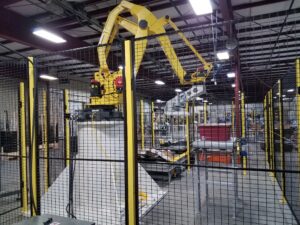
The IFR’s World Robotics 2025 report recorded 102,900 transportation and logistics service robots sold globally in 2024, a 14% year-over-year increase. Mobile intralogistics robots accounted for roughly 81,800 of those installations. That volume reflects a category that has moved from early adoption to standard operational infrastructure.
For warehouse leaders, the practical question is no longer whether robotics can work. The better question is which system type fits the constraint inside the facility.
What Types Of Robots Are Used In Modern Warehouses?
Modern warehouses deploy several robot categories, including autonomous mobile robots, automated guided vehicles, shuttle systems, goods-to-person systems, AS/RS, collaborative robots, and robotic buffering systems. Each category solves a different constraint, so system selection should follow process mapping rather than equipment preference.
The table below shows how these systems differ by function and operational fit:
| Robot Type | Primary Function | Best Fit |
| Autonomous Mobile Robots (AMRs) | Flexible piece-pick, tote, case, or pallet transport using onboard sensors | High-SKU operations needing adaptable movement without fixed conveyor infrastructure |
| Automated Guided Vehicles (AGVs) | Fixed-path point-to-point transport along pre-mapped routes | Predictable, high-volume movement where path changes are infrequent |
| Shuttle Systems / Multishuttle | High-speed case, tote, or unit retrieval inside racking structures | High-throughput distribution centers requiring dense storage and fast cycle times |
| Goods-To-Person (GTP) Systems | Deliver storage units to stationary pick workstations | Operations where picker travel time is the primary productivity bottleneck |
| AS/RS | Dense automated storage and retrieval using vertical or high-density structures | High-SKU facilities with space constraints and significant volume variability |
| Collaborative Robots (Cobots) | Assist workers with repetitive picking, packing, palletizing, or handling tasks | Facilities adding automation around existing labor workflows |
| Robotic Buffering Systems | Control inventory release timing and sequencing between processes | Operations with staging congestion, sequencing needs, or picking-to-packing coordination gaps |
The most common planning mistake is choosing a robot type before mapping the process failure point. AMRs can reduce travel time, but they do not automatically solve order sequencing. Shuttle systems can improve retrieval speed, but they may still feed congestion into packing or shipping.
Robot-as-a-Service models are also changing how operators enter the category. Lower upfront capital requirements can make pilot deployments more accessible, but a pilot still needs a real operational hypothesis. Testing automation without a defined bottleneck usually produces vague results.
How Should You Match Warehouse Robotics to the Right Use Case?
The right warehouse robotics system is the one that removes the specific constraint slowing the operation down. Start with the process problem, then match the robot type to that bottleneck. Travel time, storage density, order sequencing, labor availability, SKU complexity, and downstream timing all point toward different automation choices.
A warehouse with long picker travel paths may need AMRs or goods-to-person automation before anything else. A dense facility with limited square footage may need AS/RS, shuttle storage, or high-density automated buffering. An operation with stalled pack stations, mixed-zone orders, or uneven release timing may need robotic buffering more than another transport robot.
This scenario is where automation planning gets more precise. A robot that moves product faster can still create congestion if packing, labeling, palletizing, or shipping cannot receive product at the same rate. Good system design accounts for what happens before and after the robot touches the product.
Use-case mapping should look more like an operational diagnosis than a shopping list:
| Operational Constraint | Strong Robotics Fit | Why It Fits |
| Excessive picker walking | AMRs or goods-to-person systems | Reduces travel time and keeps workers in productive zones |
| Limited floor space | AS/RS, shuttle systems, or robotic buffering | Uses vertical or dense storage instead of expanding staging areas |
| Orders waiting between picking and packing | Robotic buffering | Holds and releases inventory based on downstream readiness |
| Predictable point-to-point movement | AGVs or conveyor-connected automation | Works well when routes are stable and process variation is low |
| Mixed-SKU order consolidation | Robotic buffering or goods-to-person automation | Helps coordinate items from multiple zones before final processing |
| Labor strain at repetitive stations | Cobots or robotic arms | Supports palletizing, induction, case handling, and repeatable picks |
The objection many operators have is cost. That concern is valid, but the better question is whether the current process is already creating hidden costs through labor overtime, missed cutoffs, staging overflow, order errors, and inefficient touches.
A phased approach often works better than a facility-wide redesign. MESH can help evaluate where robotics should move product, where software should control release logic, and where buffering can protect the rest of the system from uneven process speeds.
How Do Warehouse Robotics Systems Work Together?
Warehouse robotics systems work best when each technology handles a specific part of product flow. AMRs may move inventory, AS/RS or shuttle systems may store and retrieve it, goods-to-person stations may support picking, robotic palletizers may handle end-of-line work, and buffering may control timing between those processes.
The goal is not to automate every movement with the same type of robot. A mature system uses different automation layers where it makes operational sense.
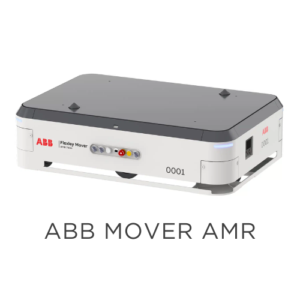 A warehouse may use AMRs to reduce walking, then route picked totes to a goods-to-person station or packing area. Another facility may rely on AS/RS for dense storage, conveyors for predictable transport, and robotic palletizing to stabilize outbound handling.
Buffering becomes critical when those connected systems do not move at the same speed. Without a controlled buffer, faster robotics can simply move the problem downstream: AMRs flood packing, AS/RS releases product before labor is ready, conveyors back up, and palletizing cells receive cases in the wrong sequence.
A robotic buffering layer gives the system a controlled place to absorb variation, hold inventory, and release product based on downstream readiness. That is what keeps individual automation gains from falling apart once the full operation is under peak pressure.
| System Layer | What It Usually Handles | Where Buffering Can Help |
| AMRs and AGVs | Movement between process points | Prevents faster transport from overwhelming packing, sortation, or palletizing |
| AS/RS and shuttle systems | Dense storage and retrieval | Holds retrieved product until downstream work is ready |
| Goods-to-person stations | Pick productivity and worker efficiency | Supports order consolidation when items come from multiple zones |
| Conveyors and sortation | Predictable movement and routing | Adds controlled dwell time when product cannot move straight through |
| Robotic palletizing | End-of-line case handling | Releases cases in a sequence that supports cleaner pallet builds |
This is the more realistic view of warehouse robotics. A robot can solve one constraint while exposing another. Faster picking can create packing congestion. Better transport can flood a downstream cell. Dense storage can still need smarter release timing.
That is why buffering deserves strategic weight in the system design conversation. It is often the difference between automation that looks fast in isolation and automation that actually holds together across picking, packing, palletizing, shipping, and peak-volume recovery.
What Should Be The Next Step In Warehouse Robotics Planning?
Warehouse robotics planning should move from system types to process fit. Once operators understand how AMRs, AS/RS, shuttle systems, goods-to-person workflows, palletizing, conveyors, and buffering interact, the next step is deciding where automation will create the most operational leverage.
That decision usually starts with a constraint: too much travel, too little storage space, poor sequencing, staging overflow, labor pressure, or uneven flow between departments. From there, the system design can be narrowed around the equipment, controls, and software logic that solve the actual problem.
For a deeper look at how robotic buffering fits inside a broader warehouse automation strategy, review MESH’s warehouse automation solutions or contact MESH Automation with a specific process challenge. From there, compare goods-to-person and robotic buffering systems when storage density and retrieval flow are central to the design.
Frequently Asked Questions About Warehouse Robotics