
Can your current setup keep up? That’s the practical question behind every warehouse automation decision.
Warehouse automation systems have changed what’s possible in storage, fulfillment, and distribution, and the performance gap between automated operations and traditional manual workflows now shows up clearly in the numbers: labor costs, throughput, accuracy, and scalability. This comparison covers where those differences show up and what a realistic transition looks like.
Traditional Warehouse Storage Workflows Explained
Traditional warehouses run on human labor and fixed storage structures. Workers walk the floor, pull from shelves, and move product by hand or with basic mechanical support.
The system works at certain volumes. But it carries real costs that compound as operations grow.
Manual Picking Processes
In a conventional picker-to-parts setup, workers travel to inventory locations to collect each item in an order. Picking accounts for roughly 55% of total operating expense in a labor-driven warehouse, and walking time drives most of that number.
At lower volumes, this is manageable. An order requiring picks from multiple zones means real floor travel per cycle, but the labor overhead stays contained. As order counts rise, that overhead scales right along with them.
Traditional Storage Layouts
Fixed shelving, rack systems, and bulk floor storage define most traditional layouts. Space gets organized around physical worker access, which limits how dense storage can get. Aisle widths are set by forklift or hand truck requirements, committing a large share of floor area to transit space rather than storage. Vertical clearance often goes unused entirely.
Labor-Driven Operations
Every touchpoint in a manual operation depends on human availability. Receiving, putaway, picking, packing, shipping: each stage needs workers present and capable.
Seasonal spikes force temporary hiring. New hires take time to train, and that staffing is hard to scale back down once the rush passes. Sick days and turnover hit throughput directly, with no buffer to absorb the gap.
What Are Warehouse Automation Systems?
Warehouse automation systems use integrated hardware and software to coordinate inventory movement, order fulfillment, and data tracking with reduced manual involvement. They range from software-only implementations to fully robotized facilities running autonomous vehicles and robotic picking arms.
Automated Workflow Coordination
The software layer covers warehouse management systems (WMS), warehouse execution systems (WES), and warehouse control systems (WCS). The WCS bridges enterprise software and the physical equipment on the floor. It processes incoming orders, directs robotic palletizers and autonomous vehicles, manages sequencing, and compiles performance metrics that feed back into planning. A well-built control system handles sorting, routing, stacking, and labeling to spec, and the data it produces gets better over time.
Robotics and Controls
Robotic picking systems, autonomous mobile robots (AMRs), and automated guided vehicles (AGVs) take over movement and handling tasks that used to require full-time headcount. They run on consistent schedules and handle repetitive work without fatigue.
FANUC arms, Omron self-guided vehicles, and similar platforms get configured for picking, palletizing, or transport based on what a facility actually needs. Underneath all of it sits the controls layer: PLCs, HMIs, servo systems. That layer gives the machines precision and flexibility to work across changing SKU mixes.
Material Handling Automation
Material handling covers the physical movement of goods through a facility. Automation changes how that movement happens at every single stage.
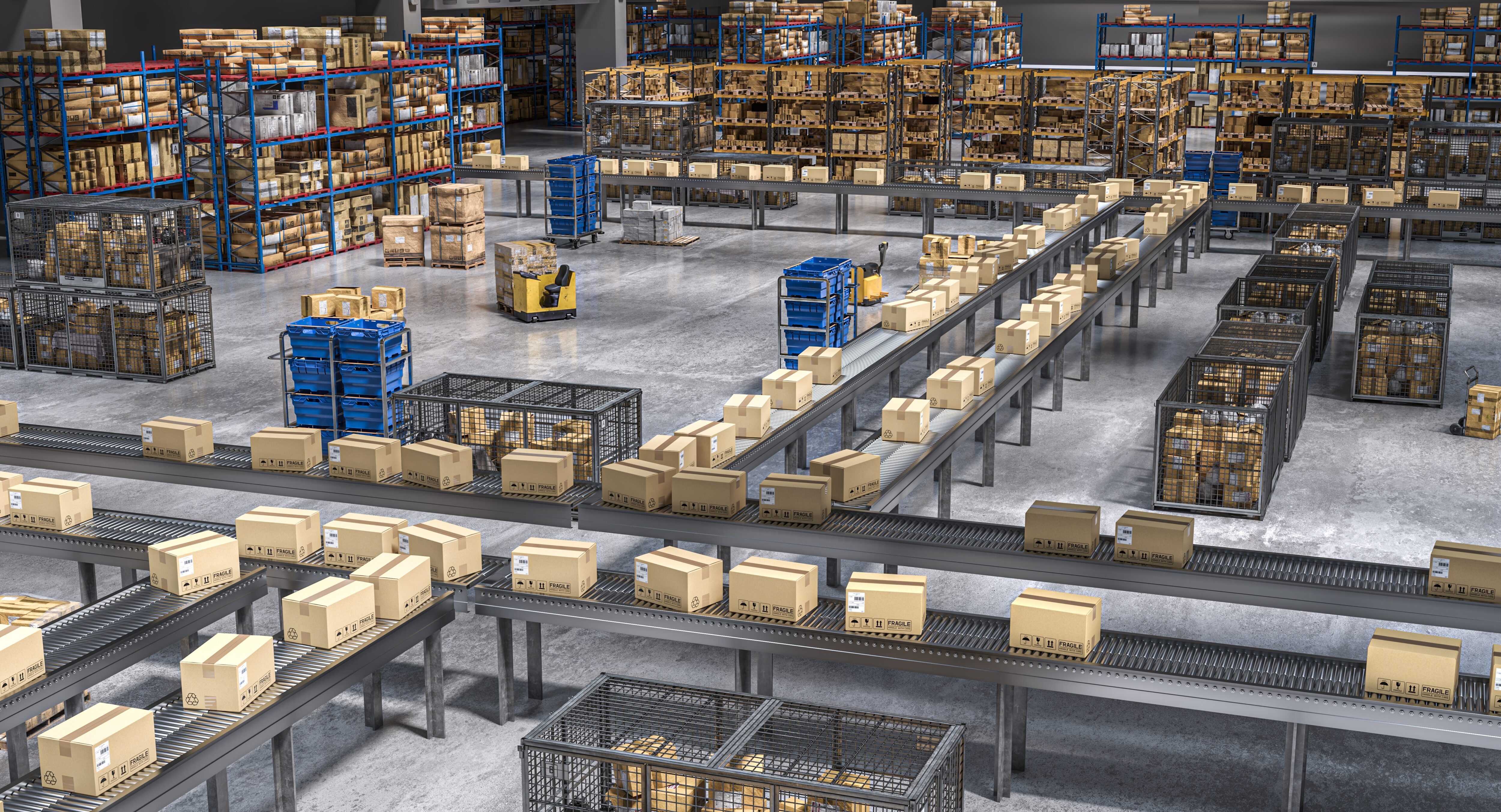
Conveyors, AS/RS, sorters, and shuttle systems move product between zones without manual transport. Robotic buffering systems add flow control between picking, packing, and shipping, holding and releasing inventory based on downstream readiness. Each station ends up running at its own pace. No bottlenecks ripple across the line.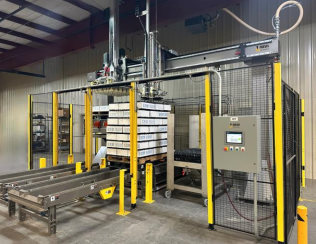
Key Differences Between Manual and Automated Operations
Manual and automated warehouses diverge across three areas: speed, visibility, and accuracy.
Process Timing
Manual operations run at a human pace. Throughput is bounded by headcount on shift and how efficiently those workers can move.
Automated systems run 24 hours a day with no shift changes and no fatigue penalty. Pick cycles that take minutes; manually compress significantly once robots handle retrieval and transport. One WMS implementation pushed a single operator past 70% more orders in a year on the same delivery timelines. The gain came from better task coordination rather than extra labor.
Workflow Visibility
In a manual warehouse, inventory tracking often depends on periodic counts or end-of-day data entry. Real-time status barely exists. Automated operations capture every movement as it happens: what got picked, when, where it sits in the cycle, what’s available next. That data feeds straight into ERP systems and flags discrepancies before they become shipment errors.
Inventory Accuracy
Human picking introduces error at every stage. Items get pulled from the wrong slot, quantities get miscounted, mislabeled product slips through unnoticed.
RFID, barcode tunnels, and computer vision catch these issues at the point of movement instead of during a returns process later. The difference shows up in the numbers: automated picking systems can cut fulfillment errors by up to 70% compared to manual workflows.
Labor Efficiency Comparisons
| Factor | Traditional Warehouse | Automated Warehouse |
|---|---|---|
| Picking method | Worker travels to product | Product moves to worker or robot picks |
| Operating hours | Shift-limited | 24/7 capable |
| Labor productivity | Baseline | Up to 85% higher (MHI data) |
| Staffing for peaks | Temp hiring, training lag | Scales by system configuration |
| Ergonomic risk | High (repetitive, physical) | Reduced, robotics handle heavy tasks |
Staffing Requirements
Automated systems reduce the headcount needed for transport, picking, and palletizing. Labor shifts toward higher-skill roles: system oversight, maintenance, exception handling.
The staffing model changes. It doesn’t disappear. Facilities running AMR fleets and robotic palletizers typically need fewer people on the floor day to day, with specialized roles focused on keeping the system performing.
Labor Consistency
A manual workforce varies naturally. Speed, accuracy, and attention shift by individual, by shift, by time of day.
Automated systems don’t have that problem. A robotic palletizer built to spec produces the same output at hour one and hour twelve. That consistency matters for order accuracy, throughput planning, and the commitments made to customers.
Safety Considerations
Overexertion, falls, and being struck by moving objects top the list of disabling warehouse injuries. Automated systems pull workers out of many of the highest-risk tasks: heavy lifting, long picking routes, proximity to fast-moving equipment. Ergonomic strain from repetitive picking eases up once product comes to the operator instead of the reverse. Facilities running robotics often see workers’ compensation claims drop measurably.
Throughput Comparisons
Automated warehouses consistently process more orders in less time, and the gap widens further during high-volume periods when manual operations start to struggle.
Order Processing Speed
Automated picking systems can lift order fulfillment speed by up to 300% compared to manual methods. AS/RS, shuttle systems, and AGVs cut travel time, the single biggest drag in manual picking, down to near zero.
Orders move through picking, packing, and staging without waiting on available workers to cross between zones.
Bottleneck Reduction
Manual warehouses develop bottlenecks wherever one process moves slower than the one feeding it. A fast receiving team overwhelms a putaway crew that can’t keep up, just as easily as a picking team outpaces packing in reverse.
Automated systems use the control layer to balance throughput across zones instead. Robotic buffering systems exist specifically for this problem: they absorb the pace difference between upstream and downstream processes so no single station backs up the whole line.
Peak Demand Handling
Peak season is the hardest test a manual warehouse faces, since temporary staffing ramps up slowly, needs training time, and introduces quality variance right when volume is highest.
Automated systems handle peaks differently. They run additional shifts without new hires and adjust task priorities through the WCS in real time. E-commerce fulfillment operations, where daily volumes swing hard, have been among the earliest and strongest adopters of this capability.
Inventory Accuracy Comparisons
Accuracy problems in warehouses get expensive fast. Mis-picks generate returns, customer complaints, and rework. Phantom inventory, stock that’s in the system but not where the record says, causes stockouts and rush orders. Automated systems address both problems at once.
Human Error Reduction
Every manual step in picking and putaway carries an error rate. Workers select the wrong item, place product wrong, or scan incorrectly under time pressure. Barcode tunnels, RFID readers, and automated verification catch discrepancies before anything ships, and fulfillment errors drop by as much as 70% when robotic picking replaces manual methods.
Tracking and Traceability
A WMS in an automated facility tracks every item through every stage: receiving, putaway, pick confirmation, pack verification, outbound scanning. That audit trail supports lot tracking, recall management, and customer inquiry responses. Manual systems depend on workers completing each scan correctly, and gaps exist wherever that doesn’t happen. Automated systems capture the data as a byproduct of running rather than as an extra task someone has to remember.
Scalability Considerations
Growing a manual warehouse means adding people and space. Growing an automated warehouse means adjusting configuration, and the physical footprint often expands less than the throughput does.
Expansion Limitations
Manual operations scale roughly in line with headcount and floor area. Automated systems scale differently, since vertical lift modules can free up as much as 90% of floor space compared to traditional racking, fitting significantly more inventory density into the same building. Adding an AMR to a fleet, or reconfiguring an AS/RS for a new SKU mix, is a different kind of scaling entirely than hiring and training dozens of seasonal workers.
Growth Planning
Phased automation supports growth without a complete facility overhaul upfront. A facility can start with WMS software and barcode verification, add conveyors and AGVs once volume justifies it, and eventually integrate robotic picking as the operation matures. The case for automation gets stronger as order volumes climb, since reduced labor costs, lower injury rates, and improved accuracy all compound in the ROI calculation.
How Companies Transition To Warehouse Automation
The move from manual to automated doesn’t require starting from scratch, since most facilities follow a phased path that manages risk and spreads capital investment over time.
 Phased Automation
Robotic Process Automation (RPA) can layer over an existing WMS to automate rule-based tasks, things like order processing, inventory updates, and shipping confirmations, without touching hardware. This improves consistency and cuts manual data entry while the facility evaluates next steps. It’s a lower-cost entry point, and it generates operational data that’s useful for planning a bigger investment later.
Retrofitting Existing Facilities
Most warehouses already sit somewhere on the automation spectrum, with conveyors, barcode scanners, and forklifts already in place. Retrofitting adds AS/RS, AGVs, robotic palletizers, or WCS software to existing infrastructure rather than building new.
MESH Automation has implemented robotic order fulfillment systems in facilities that process incoming pallets and build made-to-order pallet loads, using FANUC robots with universal vacuum tooling interfaced directly to the customer’s WMS. The existing building stays. The workflow changes.
Full System Integration
Full integration connects every piece of hardware through a WCS that talks to both the WMS and the ERP. The WCS receives orders, prioritizes them, directs robots, tracks each movement, and reports metrics back to operations management. When something needs attention, the system surfaces it on its own, and that visibility across the whole operation, from receiving to outbound, is what separates a pile of automation components from an actual warehouse automation system. For a closer look at the automated side, read our warehouse robotics guide and our explanation of how automated warehouse systems improve throughput.
Frequently Asked Questions
Getting from manual to automated is a process. Most facilities do it over time rather than all at once. MESH Automation works with operations at every stage, from first-time automation planning through full WCS integration. Contact MESH to discuss what a practical transition looks like for your facility.