
Order volumes that would have been considered a busy peak season five years ago are now a normal Tuesday for many e-commerce operations.
Ecommerce warehouse automation has become the practical answer to handling that volume, since manual operations simply run out of capacity at a certain point. This article covers why automation has become necessary for e-commerce fulfillment, where the common bottlenecks show up, and what a working automated system actually looks like in practice.
Why E-Commerce Fulfillment Requires Automation
E-commerce fulfillment requires automation because order volumes, SKU counts, and delivery speed expectations have all grown past what manual labor can reliably support at scale. The combination compounds: more orders, more products, less time per order, and a labor pool that isn’t growing to match.
Order Volume Growth
E-commerce sales reached $304.2 billion in a single quarter of 2025 in the US alone, and that volume has to move through fulfillment centers as individual orders rather than bulk shipments. Each order is small, often a single item or a handful of SKUs, and time-critical. Next-day and same-day delivery windows leave little room for slow processing. A warehouse built around manual picking and batch processing struggles to keep pace once order counts climb into the thousands per day, and the problem doesn’t ease up gradually. It tends to spike hard during specific windows like Black Friday and Cyber Monday, when demand can run three to five times normal volume.
SKU Complexity
Many e-commerce operations carry tens of thousands of active SKUs, and some carry into the millions when private label, dropship, and marketplace inventory are combined. Manual picking and inventory control become genuinely difficult at that scale. Workers need to locate specific items across a large facility, accuracy drops as SKU variety increases, and replenishment planning gets harder to manage by hand. Automated systems that track inventory in real time and direct pickers (or robots) to exact locations handle this complexity far better than paper-based or memory-dependent processes.
Faster Shipping Expectations
Same-day delivery has shifted from a premium option to a standard customer expectation in many categories. That shift puts direct pressure on how fast an order can move from “placed” to “shipped.” A facility that takes six hours to pick, pack, and stage an order cannot support same-day shipping commitments, regardless of how good the last-mile carrier is. Automation compresses the in-facility processing window, which is often the only place in the fulfillment chain where a business has direct control over speed.
Common Fulfillment Bottlenecks
Three bottlenecks show up repeatedly in e-commerce fulfillment operations: slow picking, sorting congestion, and order consolidation breakdowns. Each one compounds the others when volume spikes.
Picking Delays
Order picking is consistently the most labor-intensive and expensive activity in a warehouse, and most of that cost comes from travel time rather than the act of picking itself. Workers walking to locations, searching for items, and walking back account for a large share of the total cycle time. At low order volumes this is tolerable. At e-commerce volumes, with hundreds or thousands of small orders moving through the same facility daily, picking delays become the primary constraint on total throughput.
Sorting Congestion
Once items are picked, they need to be sorted into the correct outbound order or shipment lane. Manual sortation creates congestion points where product backs up faster than workers can sort it, particularly during multi-line order processing when several items need to converge before an order can be packed. Poor sortation flow doesn’t just slow down the affected order. It tends to back up everything moving through that part of the facility.
Order Consolidation Issues
Multi-line orders require pulling several products from different storage locations and bringing them together before packing. Poor batching and synchronization between pick zones means one delayed item holds up an entire order, even if the rest of the order completed picking minutes earlier. This is one of the more difficult coordination problems in e-commerce fulfillment, since the constraint isn’t any single picking task but the timing relationship between multiple tasks happening in parallel.
Automation Technologies for E-Commerce Warehouses
The automation technologies that address e-commerce fulfillment bottlenecks fall into three categories: robotics that handle physical movement, conveyor systems that move product between stages, and the controls layer that coordinates everything.
Robotics
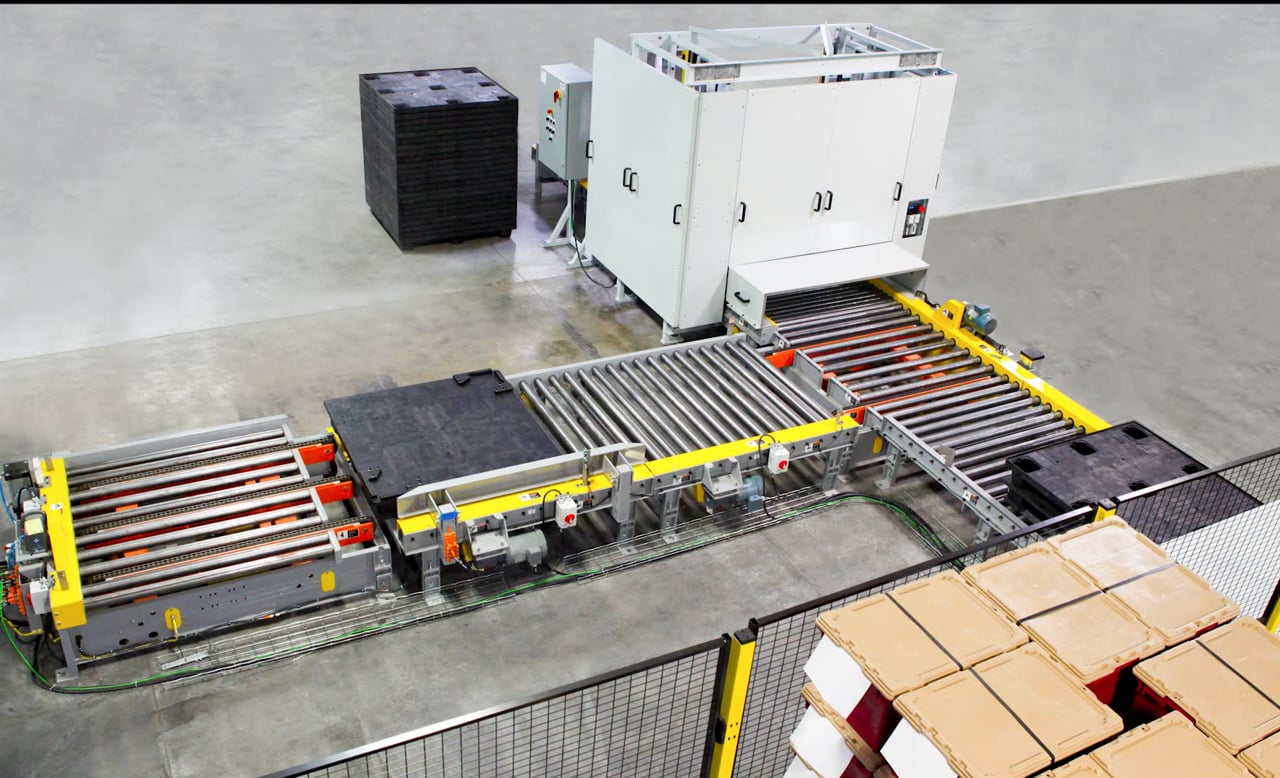
Robotic mobile fulfillment systems, AS/RS, AGVs, AMRs, and robotic pickers support 24/7 operation and dramatically reduce the per-pick travel time that drives manual picking costs. Rather than a worker walking to inventory, the inventory (or a robot carrying it) comes to a fixed picking station. Amazon alone has deployed roughly 750,000 AGVs across its facility network, and adoption has expanded well beyond the largest operators. AMRs in particular have become the fastest-growing hardware category in warehouse automation, with over 450,000 logistics robots sold worldwide in 2025 compared to 75,000 in 2019.
Conveyor Systems
Conveyors remain the backbone of physical product movement in most e-commerce warehouses, and adoption is close to universal. Survey data on Indian e-commerce operations found that around 90% of respondents use conveyor systems as a standard part of their fulfillment process. Conveyors connect picking zones to packing stations, packing stations to sortation, and sortation to shipping, moving product continuously without requiring manual carts or forklifts for short-distance transport.
Warehouse Controls
The warehouse control system (WCS) and the WMS sitting above it are what turn individual pieces of automation hardware into a coordinated operation. Warehouse control systems manage the interface between enterprise software and physical equipment, including AMR fleets, conveyors, sorters, and print-and-apply labelers. Low-code workflow automation tools are increasingly layered on top of traditional WMS platforms to integrate inventory tracking and order processing without requiring a full software replacement, which gives operations a faster path to better data visibility.
Order Consolidation and Buffering
Order consolidation is one of the harder problems in e-commerce fulfillment because it depends on timing across multiple parallel processes rather than the speed of any single station. Solving it requires sequencing and buffering logic in addition to faster equipment.
Dynamic Order Sequencing
Static batch picking, where a fixed group of orders gets picked together before moving to the next stage, performs worse than dynamic or waveless order release in most e-commerce contexts. Dynamic sequencing adjusts which orders get released and in what order based on real-time conditions: pick station availability, item location, and downstream pack capacity. This approach improves throughput and reduces the resource requirements compared with static batching, particularly when order profiles vary significantly hour to hour.
Throughput Balancing
Robotic buffering systems hold inventory in a controlled stage between picking and packing, releasing it based on downstream readiness rather than forcing every station to move at the same pace. In an e-commerce environment with multi-line orders, this lets fast-picking zones continue working at full speed while slower zones catch up, without creating a pile of half-completed orders waiting on a single missing item. The buffer absorbs the pace mismatch instead of letting it cascade into the rest of the operation.
Inventory Coordination
Stock-to-picker systems link upstream automated storage with downstream pick stations, and the coordination logic between totes, batching, and consolidation has a direct effect on overall performance. When that coordination is modeled and managed deliberately, rather than left to manual judgment calls on the floor, multi-line order consolidation becomes significantly more predictable. This matters most in operations with high order-line variability, where some orders need a single item and others need a dozen items from different zones.
Improving Pick Rates and Throughput
Pick rate improvements come from three angles: changing how goods physically move through the facility, cutting travel time directly, and getting orders released to the floor faster.
Goods Flow Optimization
 Parts-to-picker systems, where robots or AS/RS bring goods directly to a stationary picker, cut walking distance to nearly zero. Flow picking, where product moves continuously past pickers on a conveyor rather than being retrieved one order at a time, achieves a similar effect through a different mechanism. Both approaches significantly reduce the per-pick cycle time compared with traditional picker-to-parts walking. Machine-learning-enhanced robotic picking adds a further layer of improvement, increasing both speed and accuracy as the system learns from accumulated picking data.
Reducing Travel Time
Travel time has consistently been identified as the single largest component of manual picking cost, frequently exceeding the time spent on the actual pick action itself. Reducing it is less about making workers move faster and more about removing the need for movement in the first place. AS/RS, shuttle systems, and AMR-based goods-to-person setups each tackle this from a different angle, but the underlying goal is the same: get the product to the picker rather than sending the picker to the product.
Faster Order Release
Robotic mobile fulfillment systems combined with integrated scheduling minimize the time between order placement and order completion. In high-volume, time-critical environments, this matters because the cumulative effect of small per-order delays adds up quickly across thousands of daily orders. A facility that can release and process orders faster has more flexibility on cutoff times for same-day shipping, which is a meaningful competitive factor for e-commerce operators.
Reducing Labor Dependency
Labor availability has become one of the most consistent constraints on e-commerce fulfillment capacity. Automation addresses this directly by reducing how much of the operation depends on having enough people on the floor at any given time.
Labor Shortages
According to industry survey data, 76% of supply chain operations report being affected by substantial labor shortages, and 41% of warehouse managers say they cannot reliably attract and retain workers. That pressure is particularly acute during peak season hiring windows, when many operators compete for the same temporary labor pool at the same time. Automation reduces dependence on that scarce labor supply by handling repetitive, high-volume tasks without requiring proportional headcount growth.
Workforce Scalability
Automated systems scale differently than manual labor. Adding capacity to an AMR fleet or a robotic picking line doesn’t require recruiting, training, and onboarding new hires on a tight timeline before a demand spike hits. Some operations deploy additional AMR units during peak periods and recall them during slower months, keeping the active equipment fleet sized to actual demand rather than running an oversized year-round staff to cover seasonal surges. The flexibility this provides during the highest-stress weeks of the year is often where automation investment pays for itself fastest.
Scaling During Peak Demand
Peak season is the real stress test for any fulfillment operation. It’s where manual and automated capacity diverge most visibly.
Seasonal Surges
Holiday peak periods routinely push e-commerce order volumes to three to five times normal levels over a compressed window. Automated systems, including RMFS, machine-learning-driven robotic picking, and dynamic batching logic, are specifically built to absorb that kind of surge without a proportional collapse in throughput. Flexible queueing that prioritizes time-sensitive or high-priority orders during these periods helps keep service commitments intact even when total volume is at its highest point of the year.
Temporary Capacity Challenges
Manual operations historically solved peak demand by hiring temporary seasonal workers, but that approach has real limitations. New hires need training before they’re productive, accuracy tends to dip during the ramp-up period, and competition for seasonal labor intensifies industry-wide at exactly the moment every operator needs more people. Automated capacity doesn’t carry the same onboarding curve. A robotic picking system or AMR fleet that’s already integrated into the facility’s WCS performs at the same accuracy and speed during peak week as it does in a normal month.
Warehouse Automation ROI for E-Commerce
| Area | Main Automation Impact |
|---|---|
| Throughput | Higher order and pick station throughput, shorter lead times |
| Labor | Fewer pickers needed, 24/7 operation, lower labor cost per order |
| Accuracy | Fewer human errors, better real-time inventory data |
Throughput Gains
Automated and robotic systems, advanced picking technology, and AI-driven WMS platforms generally deliver measurably higher throughput and shorter processing times than comparable manual operations. The gains are most visible in facilities with high order volume and significant SKU complexity, where manual systems were already struggling before automation was introduced. AMR deployments specifically have shown payback periods under 24 months with documented ROI above 250% in live implementations.
Labor Savings
Robotics and automation reduce the number of pickers required to meet a given service level, and they reduce labor costs even after accounting for the capital investment in equipment. Some documented deployments that shift workers toward value-added oversight roles, rather than eliminating positions outright, have shown payback periods as short as eight months. That framing matters for facilities concerned about workforce transition: automation in most real deployments redirects labor rather than simply removing it.
Accuracy Improvements
Fewer human errors translate directly into fewer mis-picks, fewer mis-ships, and better real-time inventory data across the operation. For e-commerce specifically, where a single mis-shipped item generates a return, a customer service interaction, and often a negative review, the accuracy gain from automation has a downstream value that extends well past the immediate cost of the error itself. For the system-level view, see how automated warehouse systems improve throughput, then compare goods-to-person and robotic buffering systems for high-SKU fulfillment.
Frequently Asked Questions
E-commerce fulfillment doesn’t get easier with scale on its own. MESH Automation has implemented robotic order fulfillment systems for operations facing exactly these pressures, including a robotic warehouse order fulfillment system built to automate mixed palletizing and order processing for a customer managing high-volume made-to-order pallet builds. Contact MESH to discuss what an automated fulfillment system would look like for your operation.